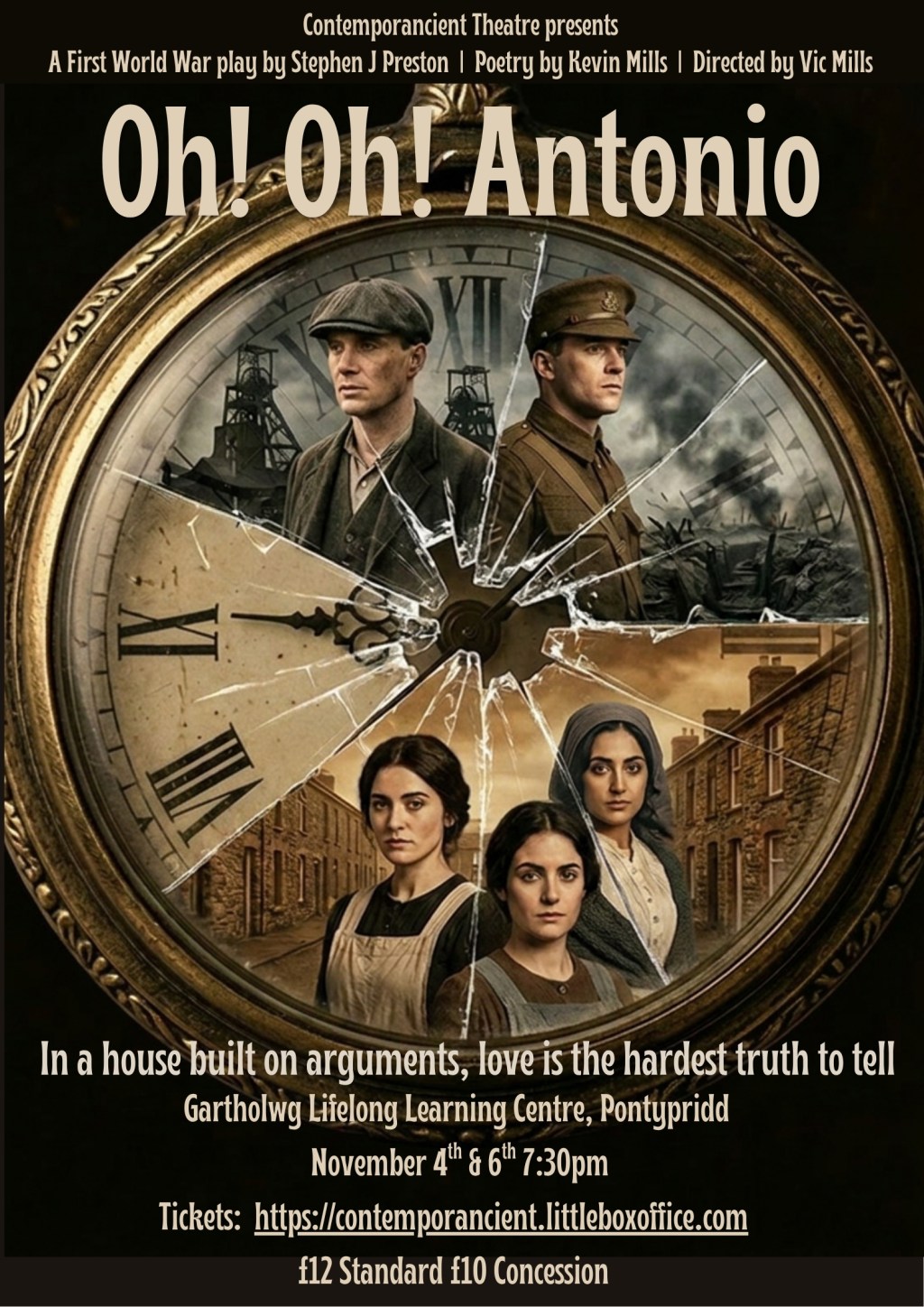
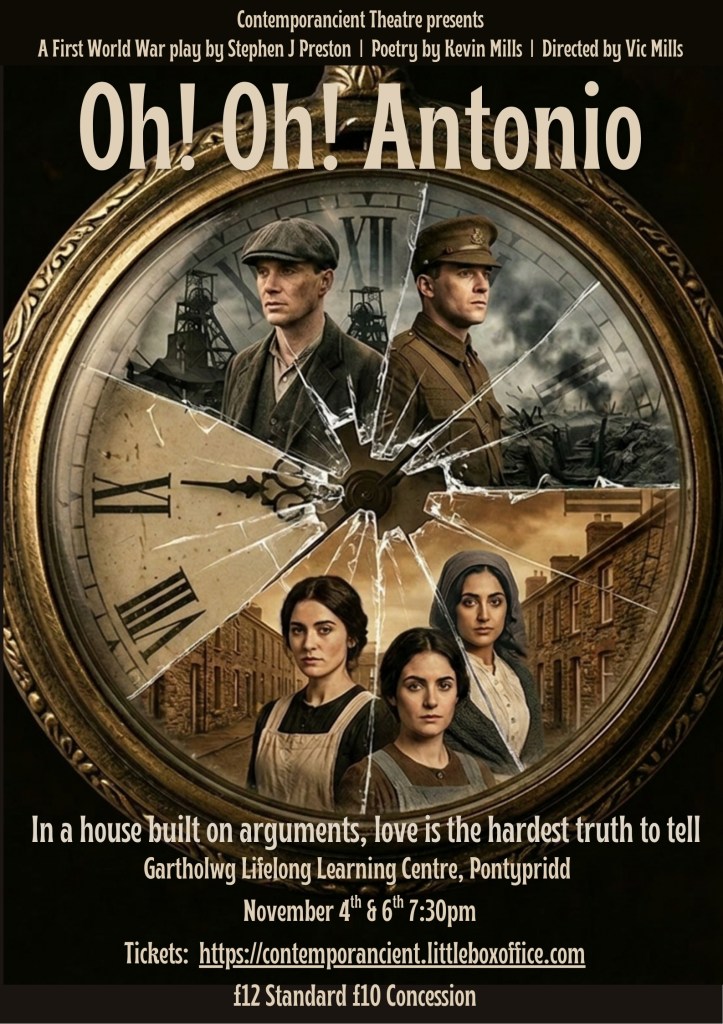
Our new production, Oh! Oh! Antonio, opens next week, and tickets are still available for all four performances.
Inspired by the old music hall song, it is Stephen J Preston’s first full-length play for professional theatre. Over a few days in 1918, as the war comes to an end, we meet a chapel-going family in Maerdy. A stranger arrives with news that shakes them to the core, but the visit also helps them face the past, and each other, and find some hope.
As with all our work, the play brings together theatre, music, poetry and film: an original score, a new collection of poems by Professor Kevin Mills, and film by Chris Lloyd.
Where and when (all at 7.30pm)
Tuesday 3rd November – Theatr Soar, Merthyr Tydfil: book here
Wednesday 4th November – Garth Olwg, Pontypridd: book here
Thursday 5th November – St Elvan’s Church, Aberdare: book here
Friday 6th November – Garth Olwg, Pontypridd: book here
Find out more on the Oh! Oh! Antonio page, and follow us on Facebook for news and behind-the-scenes photos. We hope to see you there.
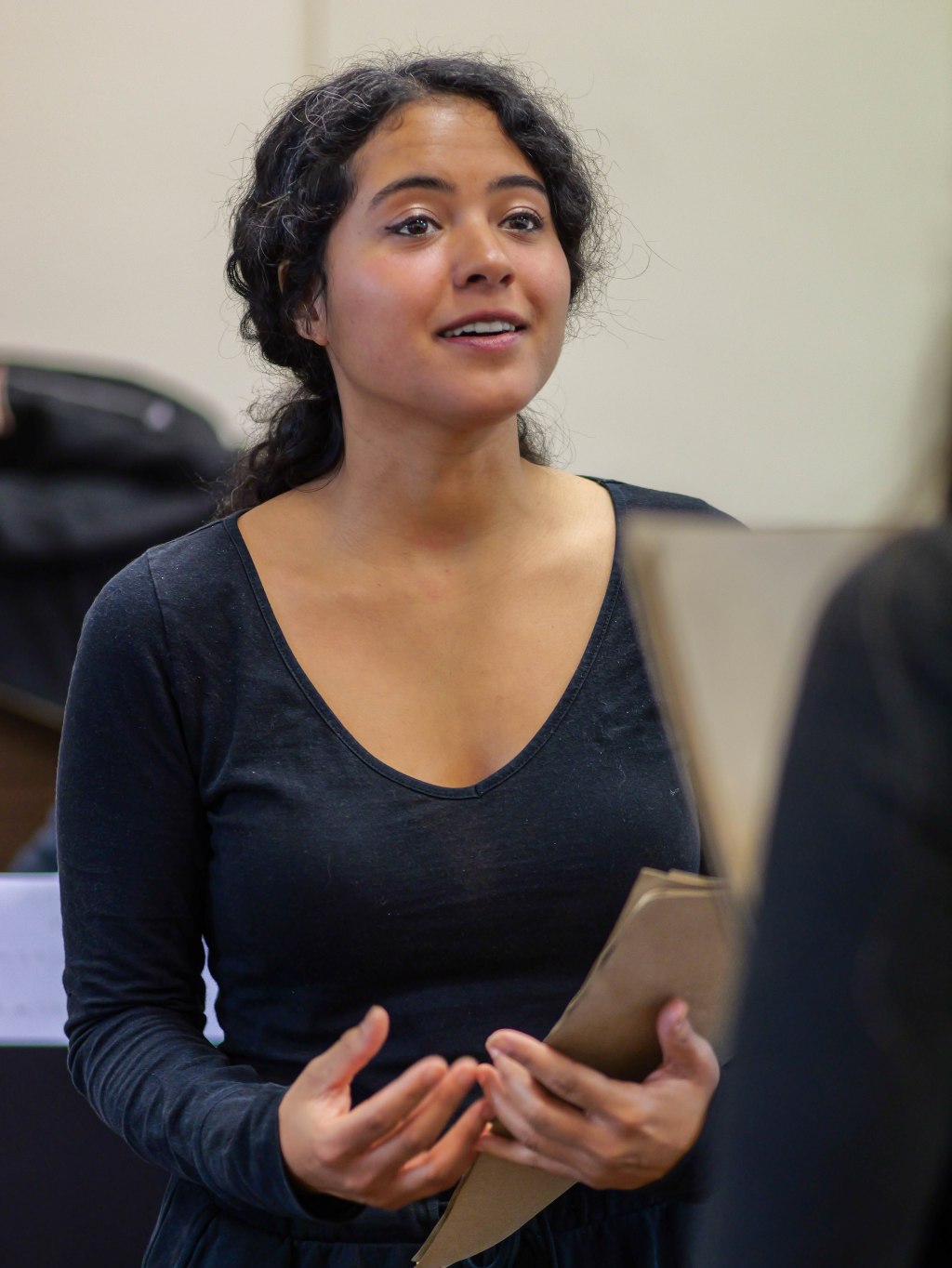
I’ve enjoyed my time with Contemporancient Theatre immensely since first meeting and working with the company in the summer of 2023 on Sanctuary: The Secrets of the Gunter Mansion. I felt so welcomed by the team. Getting to know them and learning more about Wales and Welsh culture during that month spent in Abergavenny felt like a big warm cwtch. I also enjoyed sharing elements of my own cultures with my new Welsh family (I am part Saudi, Palestinian and Yemeni), be it through food, music or words. CT’s Musical Director Steve Preston has been learning Arabic on and off, and went further to try his hand at making an intricate traditional dessert from the Arab world that even I haven’t ever attempted.
Later that same year I went to see the team perform another play, The Price of Change, at Blaengarw Workmen’s Hall. It was October 7th. Since then, my life has turned upside down. It’s been exactly two years since Israel’s assault on Gaza commenced, and every day has contained ever more horror. Gaza has been reduced to rubble, and there has been increasing violence and ethnic cleansing by Israeli forces in the West Bank, where my remaining family there is based. My 16-year-old cousin, Mohammed, was fatally shot in the head by Israeli occupying forces while standing outside of a pharmacy – caught in the ‘crossfire’ as soldiers shot at an alleged assailant from their armoured military vehicle. No investigation, no accountability – just an only son snatched from his parents, whose lives have been utterly shattered. I’ve watched friends in Gaza literally deteriorate in real time as they struggle to find food. I’ve felt guilt every day that I can’t do more to help them, whatever I manage to do – whether through fundraising or advocacy – feeling like a pittance compared to what they face. It feels immeasurably worse that I am watching this nightmare from the safety of my life here in the UK, the government of which is both historically responsible for creating the conditions for the Nakba, the mass expulsion of over 750,000 Palestinians from their lands in 1948 and ongoing destruction and ethnic cleansing of its remaining society; as well as being complicit in currently arming Israel and unconditionally shielding it from accountability, despite the UN finally recognising that it is committing genocide.
Israeli forces have destroyed over 21 cultural centres in Gaza, most of these theatres. Through indiscriminate carpet bombing, they have murdered thousands upon thousands of artists, actors, playwrights, filmmakers, dreamers. People like Mahasen al-Khateeb, one of Gaza’s most influential digital artists. She was killed in October 2024 when Israel struck a building in Jabalia refugee camp where she was sheltering with her family. Her murder came a mere few hours after she published her final illustration to her Instagram account, in which she paid tribute to Sha’ban al- Dalou, himself a 19-year-old software engineering student who burned to death alongside his mother at al-Aqsa Hospital, still attached to his IV drip, after an Israeli airstrike on the hospital grounds.
I am currently featuring in CT’s For the Love of Merthyr, an inspirational play which explores post-war Merthyr Tydfil and the early days of the NHS. I play the role of Mira, a nurse from Yemen working in the newly-formed National Health Service.
Playing the role of a medical professional, what cannot escape me is the thought of how, since October 2023, Israel has murdered over 1,500 health and humanitarian workers – supposedly a protected category under international law during armed conflict. These are not just numbers, not statistics, but lives and entire universes.
Just a few days ago, Israel killed Abed El Hameed, a staff member of Médecins Sans Frontières (MSF). He and colleagues were hit by an airstrike while waiting to board a bus to go to work at their field hospital while wearing MSF vests and clearly identified as medical humanitarian workers. El Hameed is the 15th MSF worker to be killed by Israel since the start of its onslaught. He was the “driving force” behind opening up the 3D physiotherapy department in Gaza, and helped create custom compression suits for burns patients, chiefly concerned with helping restore patients’ hope and sense of dignity. Israel commits war crime after war crime and has yet to face a shred of accountability. What allows this to continue is not only the complicity of its allied governments, but our silence.
As part of my advocacy, I work with the White Kite Collective, a grassroots group of arts and culture workers that host fundraising events sharing testimony, poetry and music from Gazans and Palestinians. Art and artists have, throughout the ages, been agents of social change. Art can not only change lives through impactful storytelling and portraying underrepresented narratives, but also through serving as a medium to speak out against injustice and oppression, and to stand with those in need.
It is more important than ever to show solidarity with Palestinians in their greatest hour of need. UN-linked reports are emerging that the death toll (direct and indirect) resulting from Israel’s genocide is likely 680,000 – mostly women and children. Soon, there will be no one in Gaza left to save. We will be left only with the rubble, and our regret for not having done more.
If you have been moved by any of the above, you can show your solidarity in both words and in action. There are many grassroots charities and fundraisers on the ground in Gaza that are in dire need of funds. If you’re unsure where to look, please feel free to contact me for guidance. Follow the work of White Kite Collective or Culture Workers Against Genocide, another brilliant group of artists and culture workers that challenge complicit funding structures in arts institutions across the UK.
And finally: your voice. Write to your MP. Organise or attend a solidarity event. Consider boycotting organisations complicit in the occupation and apartheid. There is so much more we can all be doing. The more of us speak up for Palestine, the sooner we can collectively bring this horror to an end. And the sooner Palestinians will finally see justice after 77 long and brutal years.
The United Kingdom has a long and complex history of providing refuge to those in need. From the Huguenots in the 17th century to the Syrian refugees in the 21st century, the UK has offered a home to countless individuals seeking refuge from war, persecution, and other forms of violence. However, the process of seeking refuge in the UK has never been easy, and recent changes to immigration laws have made it even more challenging. In this post, we will explore the challenges faced by individuals seeking refuge in the UK, both historically and in the present. We’ll examine the legal process, the hurdles faced by refugees upon arrival, and the role that political and social factors play in shaping the UK’s refugee policy. By understanding the challenges faced by refugees in the UK, we can work towards creating a more welcoming and inclusive society for those who seek safety and sanctuary in our country. Contemporancient Theatre’s play – Sanctuary: Secrets of the Gunter Mansion explores some of these key issues. It’s being performed in Abergavenny – a town of sanctuary, in June 2023.
1. Definition of asylum and the challenges faced in seeking refuge in the UK
Asylum is a fundamental human right granted to those who are fleeing persecution, war, and violence in their home countries. It is the protection granted by a country to someone who has left their own country as a political refugee. Seeking asylum in the UK is a difficult and challenging process, with many barriers to overcome.
One of the major challenges in seeking refuge in the UK is the extensive and complex asylum application process. This process involves filling out lengthy application forms, providing detailed information about the individual’s personal history, and attending multiple interviews to determine the legitimacy of their claim. The process can take months, sometimes years, to complete, leaving asylum seekers in a state of limbo and uncertainty.
Another challenge is the lack of access to basic services, such as healthcare and education. Asylum seekers are not entitled to work or claim benefits until their asylum application is approved, which can take a significant amount of time. This can make it difficult for them to access basic services and support themselves.
Furthermore, asylum seekers often face discrimination and hostility from the local community. Negative attitudes towards refugees and migrants can lead to social exclusion and make it difficult for them to integrate into society. This can result in isolation and mental health issues for those seeking asylum.
In summary, seeking asylum in the UK is a difficult and challenging process, with many barriers to overcome. As a society, it is important to understand these challenges and work towards creating a more welcoming and supportive environment for those seeking refuge in our country.
2. Historical perspectives on refugees and asylum seekers in the UK
Understanding the historical perspectives on refugees and asylum seekers in the UK is essential to appreciate the present challenges. The UK has a long history of providing refuge to those fleeing persecution and war, dating back to the Huguenots in the 17th century. However, it was not until after World War II that a more formalized system was established to provide protection to refugees and asylum seekers. The 1951 United Nations Convention Relating to the Status of Refugees defined who would qualify as a refugee and laid out the rights of those individuals who met the criteria.
Despite the establishment of this framework, the UK government has not always been welcoming to refugees and asylum seekers. During the 1970s, the UK accepted a large number of refugees from Uganda, but this was met with significant opposition from some quarters. In the 1980s and 1990s, the UK was less welcoming to refugees from countries such as Afghanistan, Bosnia, and Somalia. In the early 2000s, the UK government introduced a series of measures to restrict access to benefits and healthcare for asylum seekers, which made it even more difficult for them to rebuild their lives.
Today, the UK’s approach to refugees and asylum seekers remains controversial, with many arguing that the system is inhumane and lacks compassion. The UK government has been criticized for the long periods of time that people are detained in immigration centres, as well as the poor conditions in those centres. There are also concerns about the limited support provided to refugees and asylum seekers, especially when it comes to accessing employment and education.
In summary, understanding the history of refugees and asylum seekers in the UK is crucial to appreciate the current challenges. While the UK has a long history of providing refuge to those in need, the government’s approach has not always been consistent, and today’s system remains a topic of debate and controversy.
3. The 1951 Convention Relating to the Status of Refugees and its impact on the UK
The 1951 Convention Relating to the Status of Refugees is a landmark international treaty that defines who is a refugee, what their rights are, and the legal obligations of states towards them. The Convention was born out of the aftermath of World War II and was primarily designed to protect European refugees who were displaced as a result of the conflict. The UK was one of the first countries to sign the Convention, and it has since been widely acknowledged as an important legal instrument for protecting refugees’ rights and ensuring that they are treated humanely. However, despite the UK’s commitment to the Convention, there have been many challenges in practice. One of the main challenges is that the definition of a refugee is quite narrow, and many people who do not fall within its parameters are still in need of protection. Moreover, some UK governments have been criticized for their restrictive interpretation of the Convention, particularly when it comes to granting asylum. This has resulted in a backlog of asylum applications, long waiting times, and a lack of resources for refugees who are already in the country. Despite these challenges, the 1951 Convention Relating to the Status of Refugees remains an important legal instrument for protecting refugees’ rights and ensuring that they are treated humanely. It is up to the UK and other signatory states to uphold their commitment to the Convention and to find ways to improve the refugee system so that it works more effectively for those who need it most.
4. The role of the UK government in refugee and asylum seeker policy
The UK government has played a significant role in shaping the policies around refugees and asylum seekers over the years. From the 1951 United Nations Refugee Convention to the present day, the UK has been involved in developing and implementing policies that impact the lives of refugees and asylum seekers. In recent years, the UK government has faced criticism for some of its policies, including the hostile environment policy that was implemented in 2012. This policy aimed to make it difficult for illegal immigrants to live in the UK, but it has also affected many legal migrants, including those seeking asylum. The government has also faced criticism for its handling of the refugee crisis, particularly in the way it has dealt with refugees fleeing conflict in Syria. Despite the UK government accepting some refugees from Syria, many have argued that the government could do more to help those in need. In addition to these criticisms, the UK asylum system has also been criticized for its slow and inefficient processing of refugees and asylum seekers. This has resulted in many refugees and asylum seekers being left in limbo, unable to work or access basic services while their cases are being processed. Overall, the role of the UK government in refugee and asylum seeker policy is complex and has been shaped by a range of factors. While there have been some positive developments, there is still much work to be done to ensure that refugees and asylum seekers are treated with dignity and respect in the UK.
5. The challenges faced by asylum seekers in the UK today, including the hostile environment policy
Asylum seekers in the UK face a multitude of challenges in their quest for refuge. One of the biggest challenges they face today is the hostile environment policy introduced by the UK government. This policy is designed to make life as difficult as possible for migrants and asylum seekers in order to deter them from coming to the UK. Under this policy, asylum seekers are often denied access to basic amenities such as healthcare, housing, and employment. They are also subjected to stringent immigration checks and forced to prove their right to stay in the country at every turn. This can be a daunting and anxiety-inducing process, especially for those who have fled their home countries due to persecution or violence. Another challenge faced by asylum seekers in the UK is the long and complicated asylum application process. It can take months or even years for an asylum application to be processed, during which time the applicant is often left in limbo, unable to work or access support services. This can be a frustrating and demoralizing experience for asylum seekers, many of whom are already dealing with trauma and uncertainty. In addition, asylum seekers in the UK often face discrimination and prejudice from the wider society. Negative media coverage and political rhetoric can create a hostile environment for asylum seekers, making it difficult for them to integrate and feel welcome in their new communities. Overall, the challenges faced by asylum seekers in the UK are significant and complex. It is important for us to understand and address these challenges in order to create a more welcoming and supportive environment for those seeking refuge in our country.
6. The impact of Brexit on refugees and asylum seekers in the UK
The impact of Brexit on refugees and asylum seekers in the UK has been a hot topic since the referendum in 2016. There have been concerns about how leaving the European Union will affect the rights of refugees and asylum seekers, especially those who are currently seeking refuge in the UK. One of the major concerns is the end of free movement. Prior to Brexit, EU citizens were able to freely travel to the UK without the need for a visa, which meant that refugees and asylum seekers who arrived in the UK via the EU were able to do so easily. However, now that free movement has ended, refugees and asylum seekers may find it more difficult to reach the UK and access the support they need. Another concern is the impact on family reunification. The Dublin Regulation, which allows refugees and asylum seekers to be reunited with their family members in other EU countries, will no longer apply in the UK. This means that refugees and asylum seekers who have family members in the EU may struggle to be reunited with them, which can have a significant impact on their mental and emotional wellbeing. Furthermore, there have been concerns about the UK’s ability to continue to provide support and protection for refugees and asylum seekers. The UK has historically been a leader in refugee protection, but there are fears that this may change post-Brexit. With the UK government taking a tougher stance on immigration and the resettlement of refugees, there are concerns that the rights of refugees and asylum seekers may be eroded in the future. Overall, the impact of Brexit on refugees and asylum seekers in the UK is still uncertain. However, it is clear that there are significant challenges ahead, and it is important that we continue to monitor the situation and advocate for the rights of those seeking refuge in the UK.
7. The importance of public perception and media discourse in shaping attitudes towards refugees and asylum seekers
The importance of public perception and media discourse in shaping attitudes towards refugees and asylum seekers should not be overlooked. The way refugees and asylum seekers are portrayed in the media can have a significant impact on how they are treated and perceived by the general public. Unfortunately, media coverage of refugees and asylum seekers is often negative and sensationalized, with stories focusing on crime, terrorism, and other negative stereotypes. This type of coverage can create fear and mistrust towards refugees and asylum seekers, leading to discrimination and prejudice. It is important to recognize that refugees and asylum seekers are often fleeing war, persecution, and violence in their home countries. They are seeking safety and a better life for themselves and their families. By portraying them as criminals or a burden on society, we are doing a disservice to these vulnerable individuals and perpetuating harmful stereotypes. As a society, we need to work towards creating a more welcoming and inclusive environment for refugees and asylum seekers. This can be done by challenging negative media narratives, educating ourselves about the realities of the refugee experience, and advocating for policies that support their integration into society. By doing so, we can create a more compassionate and empathetic society for all.
8. The role of NGOs and civil society in supporting refugees and asylum seekers in the UK
The role of NGOs and civil society in supporting refugees and asylum seekers in the UK is critical. These organizations provide crucial assistance to individuals who often arrive in the UK with very little support or knowledge of the country or its language. NGOs work to provide refugees with housing, food, legal assistance, and healthcare, and often provide language classes and other support services. This work is essential in helping refugees integrate into their new communities, find work, and rebuild their lives. In addition to these practical services, NGOs, and civil society organizations also play an important role in advocating for the rights of refugees and asylum seekers. They work to raise awareness of the issues faced by refugees and to push for better policies and support from the government. However, NGOs and civil society organizations face their own challenges in providing support to refugees and asylum seekers. Many of these organizations are underfunded and rely on volunteers to provide services. They also face barriers in accessing government funding and can sometimes face hostility from local communities. Despite these challenges, the work done by NGOs and civil society organizations is crucial in providing support and advocacy for refugees and asylum seekers in the UK. By championing the rights of these individuals and working to build more welcoming and supportive communities, these organizations are helping to create a better future for all.
9. Personal stories of refugees and asylum seekers in the UK
Personal stories of refugees and asylum seekers in the UK can provide insight into the challenges they have faced and continue to face. Each story is unique, but they share common themes of struggle, resilience, and hope for a better future. Many have fled their homes due to war, persecution, or other forms of violence and arrive in the UK with nothing but the clothes on their backs. They often face language barriers, cultural differences, and difficulties navigating the complex asylum system. Some refugees and asylum seekers also face discrimination and racism in their new communities, leading to feelings of isolation and alienation. Despite these challenges, many refugees and asylum seekers have found ways to rebuild their lives in the UK and contribute to their new communities. It’s important to listen to and learn from the stories of refugees and asylum seekers in the UK. By understanding their experiences, we can work towards creating a more welcoming and inclusive society for all.
default
10. Ways to support and advocate for refugees and asylum seekers in the UK.
Supporting and advocating for refugees and asylum seekers in the UK is a crucial aspect of building a more inclusive and welcoming society. There are several ways in which individuals and organizations can help:
1. Volunteer with local organizations that support refugees and asylum seekers. There are many charities and non-profit organizations that work to provide legal assistance, housing, education, and other essential services to refugees and asylum seekers.
2. Donate to organizations that support refugees and asylum seekers. Financial contributions can go a long way in helping organizations provide much-needed services and support to those in need.
3. Speak out against discrimination and hate speech. As a member of society, it is important to speak up when you witness discrimination or hate speech directed towards refugees and asylum seekers. This can help create a more welcoming and inclusive environment for all.
4. Educate yourself and others about the challenges faced by refugees and asylum seekers. By learning about the experiences of refugees and asylum seekers, you can better understand the challenges they face and become a more effective advocate for their rights.
5. Engage with politicians and policymakers to advocate for more inclusive policies towards refugees and asylum seekers. This can involve writing to your local MP, participating in demonstrations, and engaging in other forms of political activism. By working together, we can create a more just and equitable society for all.
We are thrilled to be able to announce that Stephen J Preston has formally joined the company as a Director and will be our MD, Composer, Musician and Actor as we go forward. There are lots of details about Steve’s varied and impressive career on our Meet The Team page. Steve is acting in our forthcoming musical farce about a family of Welsh Elvis Presley tribute acts as well as being MD, and musician and singer for the show. Steve is composing new work for our piece about Richard Price and will be involved in composition for our work linked to religious and political refugees in Abergavenny which we are just beginning to plan.
We also welcome the wonderful Neil Maidman as Company Director, Theatre and Technical Director, Dramaturg and Actor for the company. Several of us have worked with and known Neil for many years – again, you’ll find a summary of his career on our Meet The Team page. Neil has a huge wealth of experience in all aspects of theatre and we are very fortunate to have him bring all that expertise and experience to Contemporancient Theatre. Neil joins us with the Elvis work well under way and will support us in bringing his directorial eye to the piece as well as helping us as Technical Director, as we bring the work to stages around South Wales.
We’ve been very frustrated as a new company over the last eighteen months – just like anyone else in theatre, pretty much all around the world. We have ideas, projects, and performances that we are longing to bring to the stage and to audiences but that just hasn’t been possible.
That doesn’t mean, of course, that we have been idle. We have three projects in various states of development. The first is the ‘Price Project’ – for this we have a completed script and a cast in place. We have a collection of new poetry written and a score in the process of composition. This project is for performance in 2023, to celebrate the 300th anniversary of the birth of Price. The plan is to perform in the Garw Valley initially and then to take the play elsewhere in Wales and hopefully, abroad.
The second project is a very different one indeed – looking at the more contemporary side of our mission and work – the starting point for this comedy was the annual Elvis Festival at Porthcawl – a huge event which we wanted to celebrate. This is a riotous, musical farce about a family of Welsh Elvis tribute performers. This play is in the latter stages of rehearsal and will tour venues across South Wales as soon as the pandemic conditions allow. We hope to perform the play at The Elvis Festival in Porthcawl in September 2022, also.
The third project, which is really at its inception, is a play looking at the lives of those who as a result of their beliefs, are forced to take refuge. We are focusing on ‘The Gunter House’ in Abergavenny, a place where, in the seventeenth century, Catholic priests took refuge, hiding in priest holes and in a secret chapel hidden amongst its walls. This will lead us to look at those who have travelled across the world to seek refuge in modern day Abergavenny – again in fear of their lives.
Our Director, researcher and poet, Kevin has written a new sequence of poems based on traditional songs. In the past, events such as outbreaks of the plague, disasters and social crises were memorialised in popular ballads.
‘I wanted to revive the tradition in response to the Covid 19 pandemic,’ said Kevin.
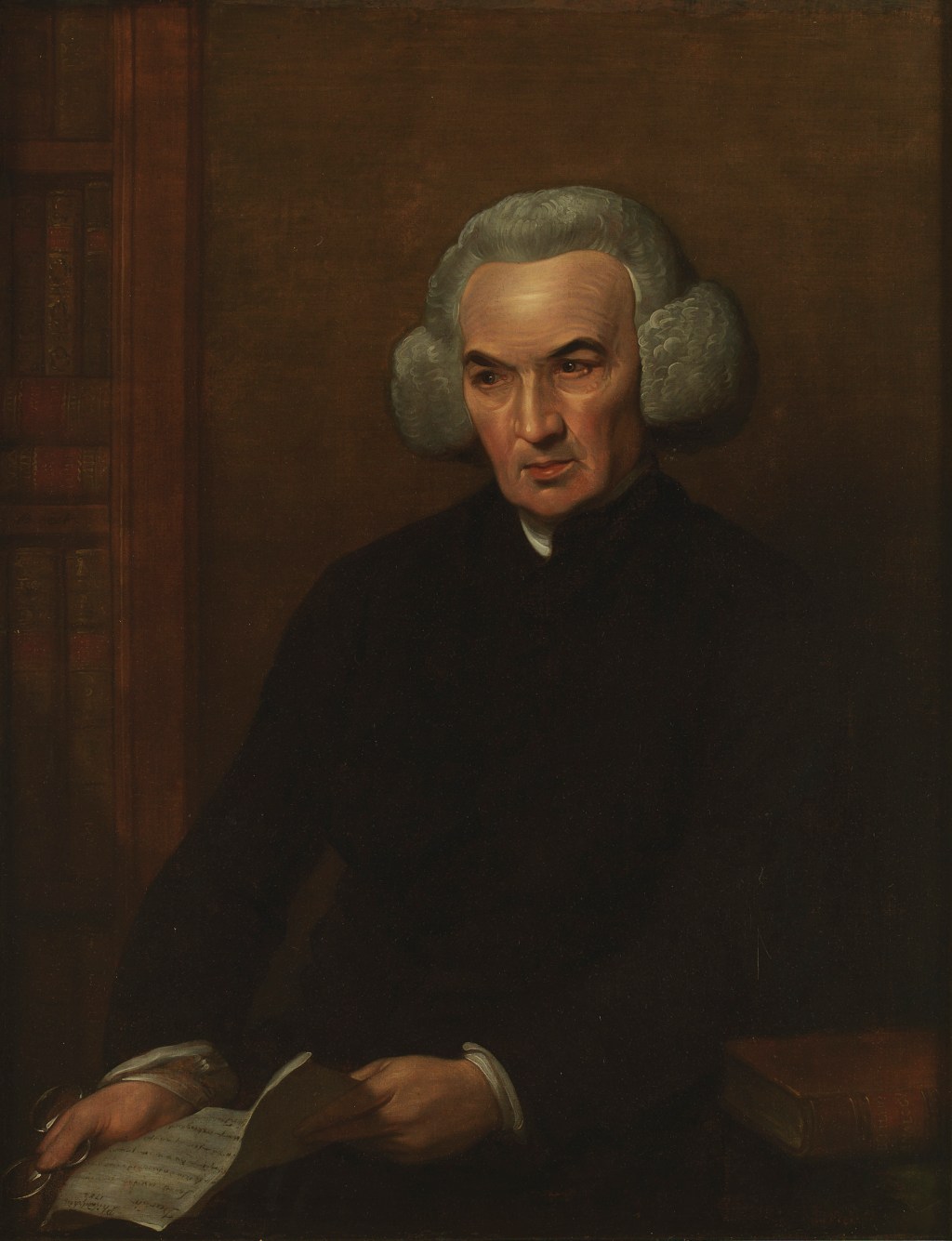
The team is busy during lockdown on a new work based on telling the story of Dr Richard Price the philosopher, theologian, political thinker, revolutionary, preacher and mathematician from Llangeinor in the Garw Valley near Bridgend in South Wales.
The team has engaged in research, collected oral histories from the Garw valley residents and begun to collaborate with renowned Pontycymer-based artist, Kevin Sinnott and with The Richard Price Society to explore possibilities for bringing this work to the Garw Valley in the coming year or so, depending on Covid 19.
The plan is to work on developing the script further in the coming months. Vic now has a draft script now completed. Kevin is working on poetry to again be central to our performance. Matthew and Jemima are now working on the script and Dave is looking actively at developing links with groups in the States with an interest in Price. This time we plan to have community members from the Garw Valley performing within the piece, through choral speaking and movement work – together with four professional actors.
At present, we are using Google Meet for readings, rehearsal and discussion of the text and this is proving both challenging and exciting. We will post clips of our meetings, readings etc on here and on social media for you to follow our progress.